



In The AI Application Layer: What Will Endure?

1. Why this matters now
AI application companies are scaling at extraordinary speed. At the same time, underlying models are becoming better and cheaper, while competitive boundaries around the application layer are blurring.
Competitive pressure can come from four directions: direct competitors, AI-native companies solving substantially the same problem or workflow; incumbents, established vendors that already own the customer relationship, workflow or system of record; infrastructure providers, companies providing the compute, data or AI infrastructure on which applications are built and that can move into the application layer; and model providers, companies supplying the underlying foundation models that can move up the stack into applications and vertical workflows.
The pressure is showing up in different ways: model providers launching directly into applications, incumbents embedding AI into existing workflows, and upstream players moving into successful application categories through internal development or acquisition.
As underlying models become dramatically better, cheaper and broadly available, what continues to compound at the application layer?
2. What are companies with traction and category leadership teaching us?
The 20 companies reviewed span several categories and collectively demonstrate that significant commercial traction and enterprise adoption are emerging at the application layer. We should not yet call them winners. The more interesting question is whether today's traction will translate into durable advantage.
Private-company revenue and valuation data should be treated as reported or estimated where applicable.
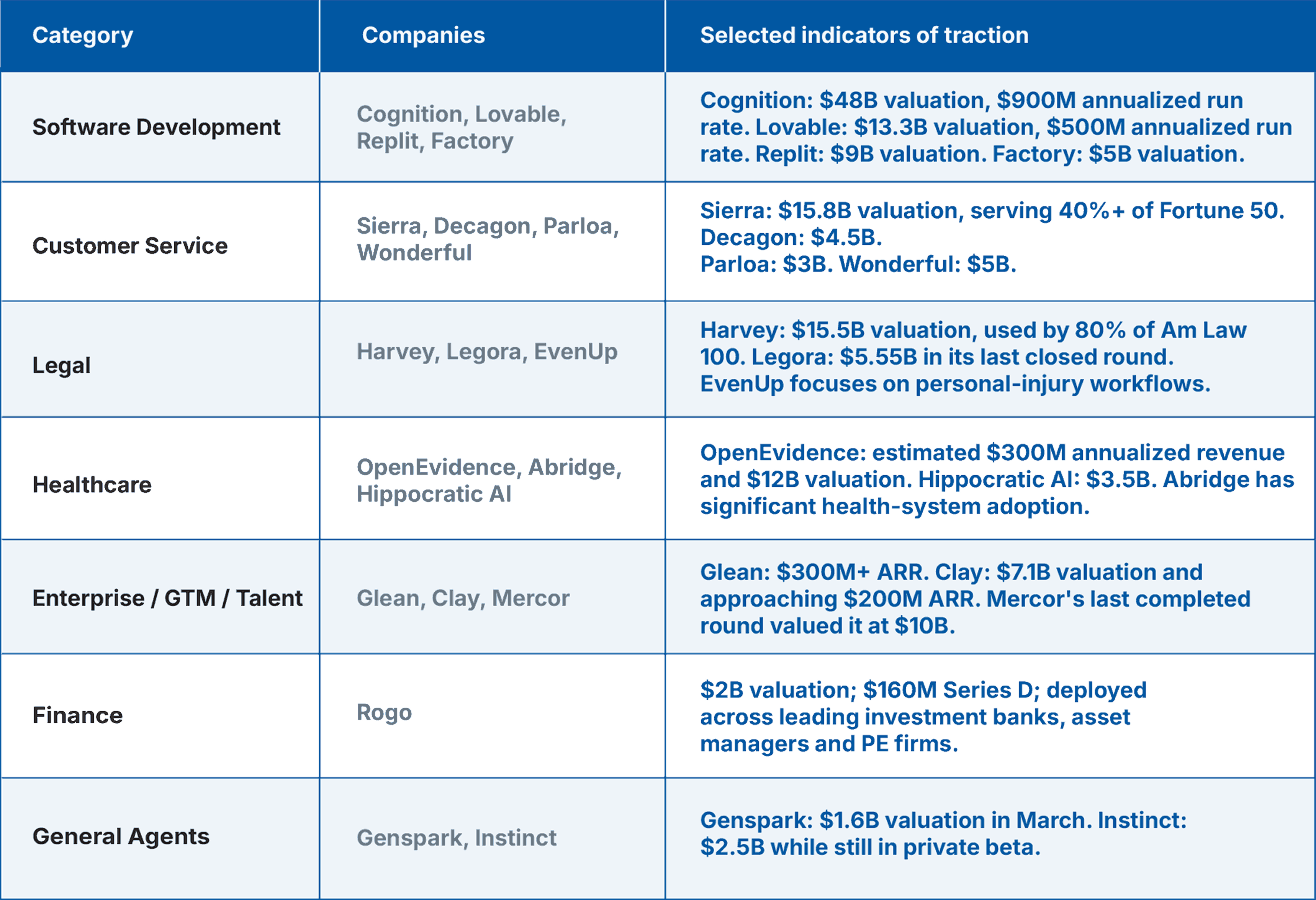
The broader pattern is important: workflow ownership alone is unlikely to provide durable defensibility, even for today's strongest vertical AI companies.
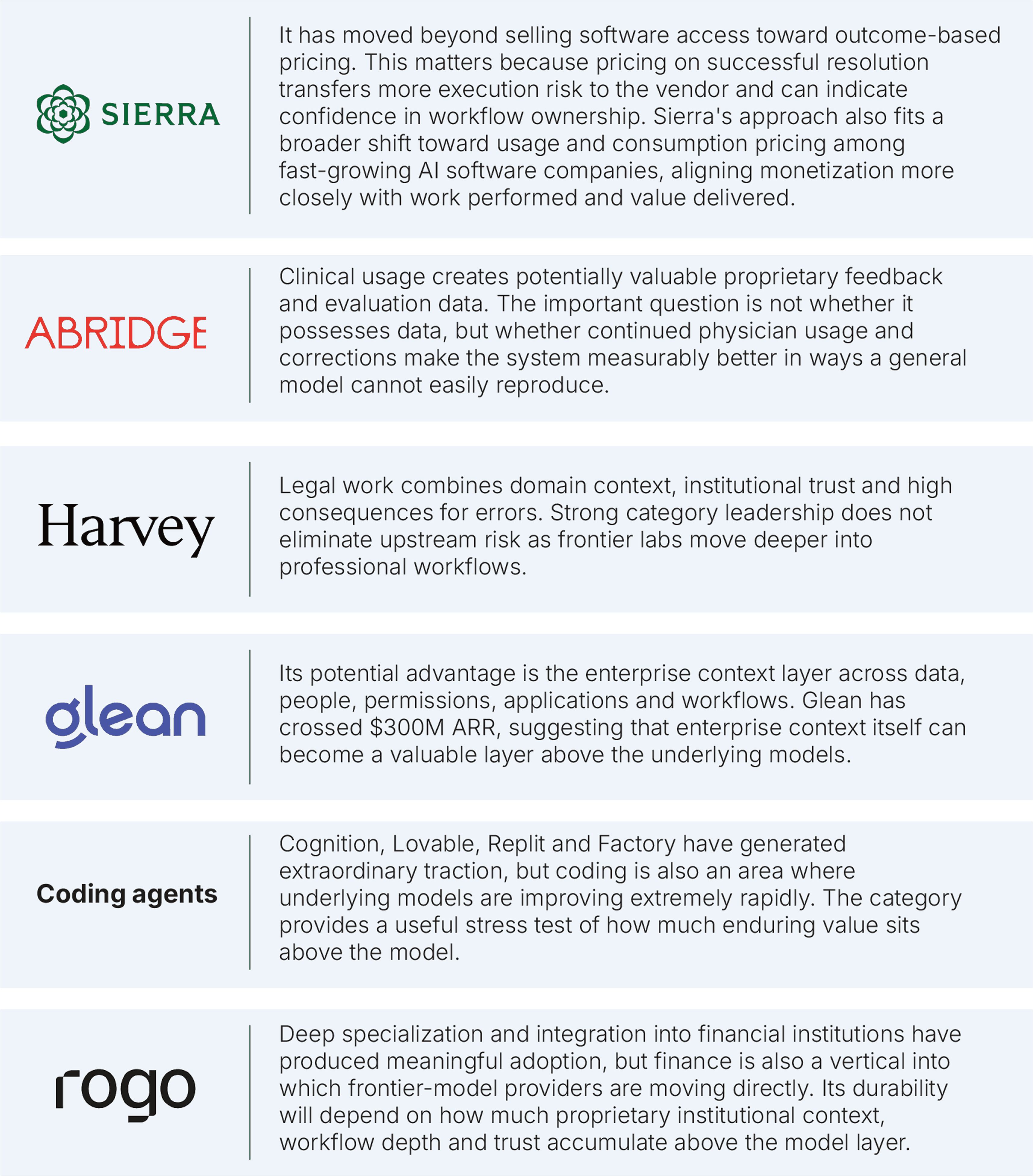
3. What could create durable defensibility?
Compounding proprietary data and intelligence
Does usage generate proprietary data, feedback or context that measurably improves the product? Data accumulation alone is not a moat. The critical question is whether the learning loop compounds with every customer, transaction or interaction.
Trust and regulatory embedding
In healthcare, financial services, semiconductors, cybersecurity, legal and other high-consequence environments, correctness, auditability, governance and institutional validation matter. If replacing a product requires an institution to revalidate the system, rebuild confidence or recreate institutional knowledge, trust can create meaningful switching friction.
Distribution and workflow embedding
Does the company sit inside a mission-critical workflow, own the customer relationship and have the right to introduce new AI capabilities into that workflow? Distribution alone is not defensibility. When combined with proprietary context, permissions, trust and switching costs, deep embedding can become a meaningful advantage.
AI-native application companies are also increasingly embedding technical teams with customers to configure workflows, integrate proprietary context and accelerate adoption. Forward-deployed engineering can accelerate the learning loop, but is not itself a moat. Its strategic value comes from turning customer-specific learning into repeatable product capabilities, proprietary context and better economics over time.
Architecture and model independence
Can the company dynamically use the appropriate frontier or open models, and the appropriate cloud, local or edge architecture, based on capability, cost, latency, privacy and control? Model orchestration itself is unlikely to be a moat. The advantage comes from the proprietary context, evaluations, workflows and learning accumulated above the models. More importantly, can the company stay differentiated if its current model supplier enters the same vertical?
Workflow depth therefore matters when it generates proprietary learning, embeds institutional trust, strengthens distribution, creates switching costs or allows the company to own measurable outcomes.
The relative importance of these sources will vary by category: enterprise systems may compound through context and distribution, regulated applications through trust and workflow embedding, and physical AI through proprietary interaction data, control intelligence and deployment learning.
Defensibility looks different by application architecture
.png)
4. The competitive stress test
Does the data loop genuinely compound and improve the product with use?
Can the company remain differentiated if its model supplier enters the same vertical?
Does the company become stronger or weaker if models become 10x better and cheaper?
The strongest application companies should not merely survive model improvement. Better and cheaper models should allow them to automate more of the workflow, move from recommendation toward execution and outcomes, expand their economic footprint with customers, and strengthen the proprietary context they accumulate.
The threat is broader than a model provider launching a competing product. Incumbents can bundle AI into existing systems of record, infrastructure providers can move into applications, and successful application categories can become targets for vertical integration.
5. What this means for investors and founders
Data accumulation is not a data moat. Proprietary data matters when continued usage creates measurable improvement that competitors cannot readily reproduce.
Workflow ownership is valuable when it compounds. Deep workflow integration becomes defensible when it creates proprietary learning or context, institutional trust, switching costs, distribution advantages or ownership of outcomes.
Forward-deployed engineering can accelerate the learning loop, but is not itself a moat. Its strategic value comes from turning customer-specific learning into repeatable product capabilities, proprietary context and better economics over time.
Trust may become more valuable as intelligence commoditizes. As baseline model capabilities become broadly available, correctness, auditability, governance and institutional acceptance may become relatively more important.
Architecture will matter alongside models. Particularly in enterprise, healthcare, semiconductors and physical AI, the ability to operate across frontier and open models, cloud and local/edge environments, while preserving security, data ownership and customer control, can itself become strategically important.
Incumbent distribution matters. AI-native companies must assume that powerful incumbents will bring increasingly capable AI into workflows they already control.
Physical-world AI has additional sources of defensibility. Proprietary interaction data, deployment learning, control systems and integration with the physical environment may matter as much as the underlying model.
Model improvement should be an accelerant, not merely something the company survives. The strongest application companies should use better and cheaper models to automate more of the workflow, move from assistance toward execution and outcomes, expand their economic footprint with customers, and strengthen the proprietary context they accumulate.
What does this company own, learn or become embedded in today that will make it materially more valuable three years from now, and does that advantage strengthen as models become dramatically better and cheaper?
As a practical heuristic, look for at least two reinforcing sources of defensibility. A proprietary data loop without trust or distribution, trust without compounding learning, or workflow integration without architecture and model independence can each be vulnerable on its own.